

paper_name stringlengths 4 399 | paper_url stringlengths 21 343 | paper_authors listlengths 0 125 | paper_abstract stringlengths 0 43.4k | paper_code stringlengths 1 149 | conf stringlengths 6 18 |
|---|---|---|---|---|---|
Toward a Programming Laboratory | https://ijcai.org/proceedings/1969/1 | [
"Warren Teitelman"
] | This paper discusses the feasibility and desirability of constructing a "programming laboratory" which would cooperate with the user in the development of his programs, freeing him to concentrate more fully on the conceptual difficulties of the problem he wishes to solve. Experience with similar systems in other fields... | # | IJCAI1969 |
On the Implementation of AMBIT/G: A Graphical Programming Language | https://ijcai.org/proceedings/1969/2 | [
"Paul Rovner",
"D. Austin Henderson Jr."
] | This paper deals with the implementation of an interactive graphical programming language for the manipulation of directed graphs. Interesting aspects of the design and a user's view of the facilities are presented. The language is a modified version of AMBIT/G; a brief description of AMBIT/G is contained in the introd... | # | IJCAI1969 |
Search for a Solution: A Case Study | https://ijcai.org/proceedings/1969/3 | [
"Robert Balzer"
] | This paper describes a series of attempts at the solution of a conceptually tough problem, the Firing Squad Synchronization Problem. These attempts demonstrate an increasing reliance on man-machine symbiosis and decreasing reliance on powerful heuristics and preplanning. These attempts consist of a clerical checking pr... | # | IJCAI1969 |
A Tablet Input Facility for an Interactive Graphics System | https://ijcai.org/proceedings/1969/4 | [
"James E. Curry"
] | Effective man-machine communication in an interactive graphics environment requires a natural and convenient way for the on-line user to input information and issue commands to the computer . Several applications have been described in which such an interface has been achieved by allowing the user to draw symbols on a ... | # | IJCAI1969 |
An Attack on the Problems of Speech Analysis and Synthesis with the Power of an On-Line System | https://ijcai.org/proceedings/1969/5 | [
"Glen J. Culler"
] | How hard a problem can you solve? The answer to this question is no longer fixed by the solver's education and intelligence alone. We are already in an era where very substantial and maneuverable on-line systems can greatly enhance our capabilities . Consequently, the difficulty of a problem must now be measured by its... | # | IJCAI1969 |
Multiple Antenna Array Signal Collecting and Processing | https://ijcai.org/proceedings/1969/6 | [
"B. Boverie",
"William D. Gregg"
] | This paper analyzes an optimal data collection and processing system for detecting a random signal field in a random noise field employing multiple antennas. The statistical model consists of a Gaussian random signal field and an independent Gaussian noise field. The time optimal data processing system to be analyzed i... | # | IJCAI1969 |
A Generalization of the k-Nearest Neighbor Rule | https://ijcai.org/proceedings/1969/7 | [
"Edward A. Patrick",
"Frederic P. Fischer II"
] | A family of supervised, nonparametric decision rules, based on tolerance regions, is described which includes the k-Nearest Neighbor decision rules when there are two classes. There are two practical reasons for doing so: first, a family of decision rules similar to the k-Nearest Neighbor rules can be specified which ·... | # | IJCAI1969 |
Geometrical Pattern Feature Extraction by Projection on Haar Orthonormal Basis | https://ijcai.org/proceedings/1969/8 | [
"Lucien A. Gerardin",
"Jacques Flament"
] | The classification of a set of patterns is a problem that appears in very many fields. In general, the number of possible classes is unknown. To define a distance (or similarity) matrix on the set of patterns, we must summarize the available date in the form of a finite set of features with an information loss as small... | # | IJCAI1969 |
Optimizing a Video Preprocessor for OCR | https://ijcai.org/proceedings/1969/9 | [
"M. R. Hartz"
] | This paper describes how optimal video preprocessor performance can be achieved using a software recognition system and a set of controlled experiments. It basically involves optimizing on a constant threshold and then using recognition logic designed from that threshold to optimize an adaptive threshold function or th... | # | IJCAI1969 |
The Effect of Noise on Visual Pattern Recognition | https://ijcai.org/proceedings/1969/10 | [
"R. L. Beurle",
"M. V. Daniels",
"B. L. Hills"
] | The work reported here is an extension of earlier work on a statistical theory of visual thresholds. Experiments are reported in which the quantum noise limitation of visual thresholds is explored further by the deliberate addition of noise to the test patterns presented to the observers. A theoretical framework is dev... | # | IJCAI1969 |
Conic Sections in Chromosome Analysis | https://ijcai.org/proceedings/1969/11 | [
"Keith A. Paton"
] | The paper describes a technique for processing alphanumeric characters to remove variations of position, size and orientation . The basis of the technique is the autocorrelation function, which is generated by comparing the character with itself for all possible displacements of the character, and which is independent ... | # | IJCAI1969 |
Recognizing Convex Blobs | https://ijcai.org/proceedings/1969/12 | [
"Jack Sklansky"
] | Because of the discrete nature of the memory and logic of a digital computer, a digital computer "sees" pictures in cellular form, each cell containing a number that represents the density of the viewed object at that cell. In particular, when the picture is binary, each cell holds a 1 or 0, depending on whether or not... | # | IJCAI1969 |
Gestalt Pattern Recognition with Arrays of Predetermined Neural Functions | https://ijcai.org/proceedings/1969/13 | [
"William D. Rowe"
] | A predetermined neural-like function which makes a ternary logical comparison to its neighbors in an array of similar functions exhibits the ability to categorize two-dimensional geometric patterns by the distinctiveness of their shape directly. This property filter is but one of a family of similar predetermined neura... | # | IJCAI1969 |
A Dynamic Pattern Recognition Method Using the Preview Controlled Saccadic Movement of the Detector | https://ijcai.org/proceedings/1969/14 | [
"Masahiro Mori",
"Kunikatsu Takase",
"Harukazu Nishio"
] | The purpose of this paper is to suggest the use of biological movements of detectors for pattern recognition. The authors demonstrate a unique method for recognizing patterns composed of straight and curved lines such as characters or edge patterns, independent of position, rotation, size, or slight deformation. The pr... | # | IJCAI1969 |
Computer-Aided Design for a Reader of Hand-Printed Characters | https://ijcai.org/proceedings/1969/15 | [
"T. Hoshino",
"K. Kiji"
] | A system has been constructed by which we can design recognition logics by trial & error, exchanging information with a computer. If the extracted features fit the experience of a man as regards his recognition of characters the system is useful, because it displays the intuitive information corresponding to demand, pe... | # | IJCAI1969 |
Recognition of Handwritten Numerals Using a Decision Graph | https://ijcai.org/proceedings/1969/16 | [
"Sumio Katsuragi",
"Hiroshi Genchi",
"Ken-ichi Mori",
"Sadakazu Watanabe"
] | An optical character reader capable of reading handwritten numerical characters has been developed and applied to mail automation. The recognition of characters is performed by extracting geometrical features out of horizontally divided zones together with their mutual connective relation . The topological structure of... | # | IJCAI1969 |
A Recognition System Using Probabilistic Decisions Based on Extracted Features | https://ijcai.org/proceedings/1969/17 | [
"P. Murden",
"M. Symons"
] | The paper describes a pattern recognition system that has been simulated using a computer with an on-line camera input. The system is adaptive, using a training set of pictures together with the names or classes to which each picture belongs. The system uses an edge following technique for extracting features from the ... | # | IJCAI1969 |
Character Recognition Using a Log-Autocorrelation Function | https://ijcai.org/proceedings/1969/18 | [
"R. L. Beurle",
"A. J. Crawford",
"R. B. Guy"
] | Chromosome analysis is complicated in that chromosomes of the same class appear in different shapes. We consider shape description in terms of conic sections. An individual chromosome is defined as a non-negative function f on the real plane, subject to certain constraints on position, size, orientation, etc. A conic s... | # | IJCAI1969 |
Adaptive Pattern Recognition | https://ijcai.org/proceedings/1969/19 | [
"P. Hauff",
"E. Neidhart"
] | A store of characteristic patterns of features is a fundamental requirement for pattern recognition . This store may be compiled either by intuition or by mathematical analysis of representative patterns. The precision of the mathematical method is considerably enhanced by statistical analysis of numerous representativ... | # | IJCAI1969 |
A Task-Independent Experience-Gathering Scheme for a Problem Solver | https://ijcai.org/proceedings/1969/20 | [
"J. Ross Quinlan"
] | A scheme for allowing a problem-solver to improve its performance with experience is outlined. A more complete definition of the scheme for a particular problem-solving program is given. Some results showing the effectiveness of the scheme are reported. | # | IJCAI1969 |
Concepts and Methods for Heuristic Search | https://ijcai.org/proceedings/1969/21 | [
"Erik Sandewall"
] | The transformation or derivation problem treated by most "problem-solving" programs is expressed in a formal notation, and various methods for "problem-solving" are reviewed. The conventional search tree is generalized into a search lattice which can accomodate multiple-input operators, e.g. resolution. The paper argue... | # | IJCAI1969 |
Application of Theorem Proving to Problem Solving | https://ijcai.org/proceedings/1969/22 | [
"C. Cordell Green"
] | This paper shows how an extension of the resolution proof procedure can be used to construct problem solutions. The extended proof procedure can solve problems involving state transformations. The paper explores several alternate problem representations and provides a discussion of solutions to sample problems includin... | # | IJCAI1969 |
PROW: A Step Toward Automatic Program Writing | https://ijcai.org/proceedings/1969/23 | [
"Richard J. Waldinger",
"Richard C. T. Lee"
] | This paper describes a program, called "PROW", which writes programs . PROW accepts the specification of the program in the language of predicate calculus, decides the algorithm for the program and then produces a LISP program which is an implementat ion of the algorithm . Since the construction of the algorithm is obt... | # | IJCAI1969 |
An Introduction to the Heuristic Programming System | https://ijcai.org/proceedings/1969/24 | [
"David K. Jefferson"
] | The Heuristic Programming System is a language. designed but not yet implemented, for research in artificial intelligence. It will provide facilities for creating, modifying, and destroying complex hierarchically structured objects and descriptions of objects. A search operation will be provided to retrieve objects whi... | # | IJCAI1969 |
On a Tool in Artificial Intelligence Research: An Associative Memory, Parallel Language, AMPPL-II | https://ijcai.org/proceedings/1969/25 | [
"Nicholas V. Findler",
"Wiley R. McKinzie"
] | One of the remarkable things about human information processing is the way we store and retrieve information. The human associative memory is a device that has been only rather crudely approximated with computers in flexibility, selfmodifiability, and complexity of associations. In this paper, we describe a computer la... | # | IJCAI1969 |
A Lifelike Model for Associative Relevance | https://ijcai.org/proceedings/1969/26 | [
"Paul B. Post"
] | This paper deals with the general problem of association in artificial intelligence. The suggested approach is based on a multidimensional information space that organizes itself as a large number of elementary associations are supplied. The space contains such entities as words, technical terms, symbols, phrases, and ... | # | IJCAI1969 |
Completeness Theorems for Semantic Resolution in Consequence-Finding | https://ijcai.org/proceedings/1969/27 | [
"James R. Slagle",
"Chin-Liang Chang",
"Richard C. T. Lee"
] | The object of consequence-finding is to deduce logical consequences from a set of axioms. The theory of J.R. Slagle's semantic resolution principle, an inference rule for first-order predicate calculus, is extended to consequence-finding. Given an interpretation I, it is proved that any prime (non-trivial) consequence,... | # | IJCAI1969 |
E-Resolution: Extension of Resolution to Include the Equality Relation | https://ijcai.org/proceedings/1969/28 | [
"James B. Morris"
] | The E-Resolution inference principle described in this paper is a single-inference logic system for the first-order predicate calculus with equality. Special axioms for equality (i.e., axioms for symmetry, reflexivity, transitivity, and substitutivity) are not required to be added to the original set of clauses. Other ... | # | IJCAI1969 |
PLANNER: A Language for Proving Theorems in Robots | https://ijcai.org/proceedings/1969/29 | [
"Carl Hewitt"
] | PLANNER is a language for proving theorems and manipulating models in a robot. The language is built out of a number of problem solving primitives together with a hierarchical control structure. Statements can be asserted and perhaps later withdrawn as the state of the world changes. Conclusions can be drawn from these... | # | IJCAI1969 |
Computer Solution of Calculus Word Problems | https://ijcai.org/proceedings/1969/30 | [
"Eugene Charniak"
] | A program was written to solve calculus word problems. The program, CARPS (CAlculus Rate Problem Solver), is restricted to rate problems. The overall plan of the program is similar to Bobrow's STUDENT, the primary difference being the introduction of "structures" as the internal model in CARPS. Structures are stored in... | # | IJCAI1969 |
Theorem Provers as Question Answerers | https://ijcai.org/proceedings/1969/31 | [
"Jared L. Darlington"
] | This paper describes a deductive question-answering computer program that uses the Robinson resolution procedure to perform logical inferences and retrieve facts on the basis of a fairly large body of stored data. Irrelevant searches and inferences are kept to a minimum by means of some recently developed theorem-provi... | # | IJCAI1969 |
Dialogues Between Humans and an Artificial Belief System | https://ijcai.org/proceedings/1969/32 | [
"Kenneth Mark Colby",
"David Canfield Smith"
] | An artificial belief system capable of conducting on- line dialogues with humans has been constructed . It accepts information , answers questions and establishes a credibility for the information it acquires and for its human informants . Beginning with beliefs of high credibility from a highly believed source , the s... | # | IJCAI1969 |
A Net Structure Based Relational Question Answerer: Description and Examples | https://ijcai.org/proceedings/1969/33 | [
"Stuart C. Shapiro",
"George H. Woodmansee"
] | A question answering system is described which uses a net structure for storage of information. The net structure consists of nodes and labelled edges, which represent relations between the nodes. The labels are also nodes, and therefore definitions of relations may be stored in the net. It is demonstrated that the gen... | # | IJCAI1969 |
Cyclic Behavior of Randomly Growing Digital Structures in Finite Random Environment | https://ijcai.org/proceedings/1969/34 | [
"Konrad R. Fialkowski"
] | Computer experiments with a model of a randomly growing structure with the possibility of division are presented. In agreement with the set of conditions, the growing structures are considered as evolutionary sequences. The randomly growing digital structure could achieve unchangeable "shape" in each evolutionary gener... | # | IJCAI1969 |
Characteristics and Organizing Capability of Statistical Organizer | https://ijcai.org/proceedings/1969/35 | [
"Shoichi Noguchi",
"Juro Oizumi"
] | This paper presents some fundamental properties of a statistical organizer that are considered from the view point of system organization and organizing capability. The system performance is evaluated by means of the concept of the information processing capacity under the assumption that the pattern is distributed acc... | # | IJCAI1969 |
Learning Technique and the Stochastic Approximation Method | https://ijcai.org/proceedings/1969/36 | [
"Fridrich Sloboda",
"Jaroslav Fogel"
] | In the paper is presented a new method for accelerating the convergence of the stochastic approximation method,which can be used as a mathematical technique to solve some learning problems. | # | IJCAI1969 |
The Learning of Parameters for Generating Compound Characterizers for Pattern Recognition | https://ijcai.org/proceedings/1969/37 | [
"Leonard Uhr",
"Sara Jordan"
] | This paper presents and describes a pattern recognition program with a relatively simple and general basic structure upon which has been superimposed a rather wide variety of techniques for learning, or self-organization. The program attempts to generalize n-tuple approaches to pattern recognition, in which ann-tuple i... | # | IJCAI1969 |
A Pattern Classification by the Time-Varying Threshold Method | https://ijcai.org/proceedings/1969/38 | [
"Shuhei Aida",
"Gen-ichiro Kinoshita"
] | An element having the mechanism of timevarying threshold has been proposed by S. Aida and denoted as an IMICTRON. Several applications of the IMICTRON have already been discussed. The most distinguishing property of the IMICTRON is its time-varying threshold level with a function of reintegration, which makes it possib... | # | IJCAI1969 |
Some Properties of Small Networks of Randomly Connected Artificial Neurons | https://ijcai.org/proceedings/1969/39 | [
"R. B. Guy",
"R. L. Beurle"
] | The activity in small networks of randomly connected artificial neurons, simulated on a digital computer, is described. Networks with only excitatory connections, and networks with both excitatory and inhibitory connections are considered. | # | IJCAI1969 |
Computer Simulation of Articulatory Activity in Speech Production | https://ijcai.org/proceedings/1969/40 | [
"Paul Mermelstein"
] | A computer facility for modeling sound production resulting from exciting a moving articulatory system is described. The vocal tract is treated as an acoustic transmission line with variable crosssectional area. The system allows on-line specification of the history of articulatory states (vocal-tract shapes) and excit... | # | IJCAI1969 |
Remarks on the Problem of the Logical Design of the Vertebrate Visual System | https://ijcai.org/proceedings/1969/41 | [
"Richard E. Warren"
] | Most interesting machine tasks, e.g., visual pattern recognition, require large complex systems. Conventional machine designs are not well suited to the reliability demands of large complex systems. Many designs, conceived and tested on a small scale, and theoretically extendable to large scale systems, are still awkwa... | # | IJCAI1969 |
Human Control of Remote Computer-Manipulators | https://ijcai.org/proceedings/1969/42 | [
"Thomas B. Sheridan",
"William R. Ferrell"
] | This paper describes a man-computer-manipulator system for doing a variety of exploration and assembly tasks for space, undersea, hazardous terrestial environments, warehousing and medical applications. Emphasis is placed upon the allocation of functions to man and machine and the nature of their on-line interaction. T... | # | IJCAI1969 |
State Space Models of Remote Manipulation Tasks | https://ijcai.org/proceedings/1969/43 | [
"Daniel E. Whitney"
] | A state variable formulation of the remote manipulation problem is presented, applicable to human supervised or autonomous computer-manipulators. A discrete state vector, containing position variables for the manipulator and relevant objects, spans a quantized state space comprising many static configurations of object... | # | IJCAI1969 |
A Mobile Automaton: An Application of Artificial Intelligence Techniques | https://ijcai.org/proceedings/1969/44 | [
"Nils J. Nilsson"
] | A research project applying artificial intelligence techniques to the development of integrated robot systems is described. The experimental facility consists of a n SDS-940 computer and associated programs controlling a wheeled vehicle that carries a TV came r a and other sensors. The primary emphasis is on the develo... | # | IJCAI1969 |
The Stanford Hand-Eye Project | https://ijcai.org/proceedings/1969/45 | [
"Jerome A. Feldman",
"Gary M. Feldman",
"Gilbert Falk",
"Gunnar Grape",
"J. Pearlman",
"Irwin Sobel",
"Jay M. Tenenbaum"
] | There is a large continuing project at Stanford Artificial Intelligence Laboratory aimed towards the development of a system capable of interesting perceptual-motor behavior. This paper presents a brief outline of the currently active efforts and suggests references for more detailed information. A more thorough discus... | # | IJCAI1969 |
Robot Control Strategy | https://ijcai.org/proceedings/1969/46 | [
"Leonard Friedman"
] | A behavioral theory of information processing based on ethological observations has been tested experimentally by programming a robot control system. The resultant software has successfully simulated robot operation. Three basic types of software modules are assumed as elements. These accept input stimuli and generate ... | # | IJCAI1969 |
MIKROKOSMS and Robots | https://ijcai.org/proceedings/1969/47 | [
"Leonard Uhr",
"Manfred Kochen"
] | This pape rpresents a computer program that simulates situations (called " MIKROKOSMS") in which severl entities (called " organisms ") wander around in an environment that includes one another plus other, apparently simpler, entities (called " objects"). The program has a rather simple set of "laws " of objects , whic... | # | IJCAI1969 |
An Augmented State Transition Network Analysis Procedure | https://ijcai.org/proceedings/1969/48 | [
"Daniel G. Bobrow",
"J. Bruce Fraser"
] | syntactic analysis procedure is described which obtains directly the deep structure information associated with an input sentence . The implementation utilizes a state transition network characterizing those linguistic facts representable in a context free form, and a number of techniques to code and derive additional ... | # | IJCAI1969 |
A Conceptual Parser for Natural Language | https://ijcai.org/proceedings/1969/49 | [
"Roger C. Schank",
"Lawrence G. Tesler"
] | This paper describes an operable automatic parser for natural language . It is a conceptual parser, concerned with determining the underlying meaning of the input uti li zing a network of concepts explicating the beliefs inherent in a piece of discourse. | # | IJCAI1969 |
Using Relational Operators to Structure Long-Term Memory | https://ijcai.org/proceedings/1969/50 | [
"Alan L. Tharp",
"Gilbert K. Krulee"
] | This paper describes a system for "remembering" a story or passage in English and for the subsequent retrieval of responses to questions. Although it functions as an information retrieval system, it is also intended as a model for long-term human memory. Information is stored in the form of predicates and property list... | # | IJCAI1969 |
Talking with a Robot in English | https://ijcai.org/proceedings/1969/51 | [
"L. Stephen Coles"
] | This paper gives an overview of the present status and future plans of a research project aimed at communicating in natural language with an intelligent automaton, The automaton in question is a computer-controlled mobile robot capable of autonomously acquiring information about its environment and performing tasks nor... | # | IJCAI1969 |
A Contextual Recognition System for Formal languages | https://ijcai.org/proceedings/1969/52 | [
"Stephen C. Darden"
] | This paper describes work in progress aimed a t obtaining a practical recognition system by filtering the noisy output of an inexpensive character classifier through multiple stages of context analysis to produce high-quality final output. The s y stem is designed to process the text of handprinted formal languages, su... | # | IJCAI1969 |
Web Grammars | https://ijcai.org/proceedings/1969/53 | [
"John L. Pfaltz",
"Azriel Rosenfeld"
] | Classes of "phrase-structure grammars" are defined whose "languages" consist, not of strings of symbols, but of directed graphs with symbols at their vertices ("webs"). Examples of such "web grammars" are given, having languages consisting of trees, of two-terminal series-parallel networks, and of "triangular" networks... | # | IJCAI1969 |
A Formal Description for Two-Dimensional Patterns | https://ijcai.org/proceedings/1969/54 | [
"Charles T. Zahn Jr."
] | A "structural description" for two-dimensional black and white patterns is defined as the set of contour lines for an appropriate function which fits the binary pattern. These contour lines are mutually nonintersecting closed polygonal curves with edges in only eight different directions and they represent the boundari... | # | IJCAI1969 |
Machine Perception and Description of Pictorial Data | https://ijcai.org/proceedings/1969/55 | [
"Martin A. Fischler"
] | This investigation of machine processing of pictorial data is based on the premise that people can recognize visual objects and describe them well enough so that other individuals can recognize the object from the description. Given a system of linguistic communication between a person and a digital computer, and given... | # | IJCAI1969 |
Implicational Molecules: A Method for Extracting Meaning from Input Sentences | https://ijcai.org/proceedings/1969/56 | [
"Robert P. Abelson",
"Carol M. Reich"
] | A generally overlooked possibility for extracting pragmatic meaning from sentence inputs is discussed, This possibility draws upon the psychology of the subjective attribution of causes to stimulus events. Application to the design of conversational programs is feasible, although the present work concerns application t... | # | IJCAI1969 |
Experiments with a Search Algorithm for the Data Base of a Human Belief System | https://ijcai.org/proceedings/1969/57 | [
"Kenneth Mark Colby",
"Lawrence G. Tesler",
"Horace J. Enea"
] | A large data base was collected from a human informant . The data consisted of beliefs regarding parent - child r e la t ion s . A variety of factors in searching the data base were manipulated in an attempt to discover which were the more important in contributing to estimates of credibility . Problems of data collect... | # | IJCAI1969 |
The Modeling of Simple Analogic and Inductive Processes in a Semantic Memory System | https://ijcai.org/proceedings/1969/58 | [
"Joseph D. Becker"
] | "It is part of our thesis that concepts in the strict sense of the term, as we k now them - which, since Euler , the great mathematician (1707-1783), are represented by circles, a fact which means far mo r e than meets the eye - are foreign to the Chinese mind ." - Gustav Herdan, Linguistics No . 28 | # | IJCAI1969 |
Cognitive Processes and III-Defined Problems: A Case Study from Design | https://ijcai.org/proceedings/1969/59 | [
"Charles M. Eastman"
] | In this paper the information processing theory of problem solving is extended to include ill-defined problems. A protocol of problem solving in architectural design and its analysis is presented. The significant difference between well- and ill-defined problem solving is shown to be a specification process similar to ... | # | IJCAI1969 |
Explorations with a Simulation Model of Short-Term Memory | https://ijcai.org/proceedings/1969/60 | [
"Kenneth R. Laughery",
"Allen L. Pinkus"
] | A simulation model of human short-term memory has been formulated. The model postulates a number of basic information processes which are executed in a serial fashion and each has an associated time parameter. The model also postulates that information is lost from memory as a result of decay. The nature of this decay ... | # | IJCAI1969 |
A Computer Model for Certain Classes of Verbal Behavior | https://ijcai.org/proceedings/1969/61 | [
"George R. Kiss"
] | A computer model of some classes of verbal behaviour is described. The general characteristic of the classes is that the subjects emit discrete verbal units but not continuous discourse. The concept of a word store is defined as a stochastic information retrieval system, implemented in the form of a network of stochast... | # | IJCAI1969 |
Analogy Between Sequential Errors in Aphasia and the Behavior of a Cybernetic System (SARF) | https://ijcai.org/proceedings/1969/62 | [
"Daniel Bertaux",
"André-Roch Lecours",
"François Lhermitte"
] | ANALOGY BETWEEN SEQUENTIAL ERRORS IN APHASIA AND THE BEHAVIOUR OF A CYBERNETIC SYSTEM (SARF) Daniel Bertaux, Andre-Roch Lecours and Frangois Lhermitte Centre National de la Recherche Scientifique Hepital de la Salp~triere, Paris, France ABSTRACT A comparison is made between a very frequent type of error in aphasia ("Se... | # | IJCAI1969 |
An Accommodating Edge Follower | https://ijcai.org/proceedings/1971/1 | [
"Karl K. Pingle",
"Jay M. Tenenbaum"
] | We describe an operational program that locates objects in a television image and traces their edges . The program accommodates the television camera, maximizing dynamic range during acquisition and sensitivity during tracing, to obtain the most appropriate image for each phase. If the trace routine loses an edge, vari... | # | IJCAI1971 |
Mathematical Models for Automatic Line Detection | https://ijcai.org/proceedings/1971/2 | [
"Arnold K. Griffith"
] | The goal of the work here reported Is to Investigate algorithms which find the real straight edges In scenes consisting of prismatic sol Ids, taking Into account smooth variations In Intensity over faces, blurring of edges, and noise. To this end we give In this paper a model of the appearance to an opt leal Input devi... | # | IJCAI1971 |
Heuristic Algorithms for Automated Space Planning | https://ijcai.org/proceedings/1971/3 | [
"Charles M. Eastman"
] | This paper reviews the major characteristics of existing programs for automatically solving space planning problems. It outlines general features of this class of problem and introduces a set of heuristic decision rules called Constraint Structured Planning, which in preliminary tests have efficientl y solved a variety... | # | IJCAI1971 |
A Heuristic Programming Study of Theory Formation in Science | https://ijcai.org/proceedings/1971/4 | [
"Bruce G. Buchanan",
"Edward A. Feigenbaum",
"Joshua Lederberg"
] | The Meta-DENDRAL program is a vehicle for studying problems of theory formation in science. The general strategy of Meta-DENDRAL is to reason from data to plausible generalizations and then to organize the generalizations into a unified theory. Three main subproblems are discussed: {1) explain the experimental data for... | # | IJCAI1971 |
Collective Behaviour of Automata and the Problems of Stable Local Control of a Large-scale System | https://ijcai.org/proceedings/1971/5 | [
"Vadim L. Stefanuk"
] | # | IJCAI1971 | |
Challenge to Artificial Intelligence: Programming Problems to be Solved | https://ijcai.org/proceedings/1971/6 | [
"Jean E. Sammet"
] | This paper is in the nature of a challenge to artificial intelligence experts . It suggests t hat the techniques of artificial intelligence should be applied to some realistic problems wh i ch exist in the programming and data processing f i elds. After a brief review of the little related existing work which has been ... | # | IJCAI1971 |
Grid Coding: A Preprocessing Technique for Robot and Machine Vision | https://ijcai.org/proceedings/1971/7 | [
"Peter M. Will",
"Keith S. Pennington"
] | The problem of machine vision as evidenced in the various robot projects in existence is attacked by analogy with the supposed nature of human visual processing in that edges are enhanced, texture is examined and various heuristic approaches are studied. This paper describes a non-anthropomorphically based method of de... | # | IJCAI1971 |
Extraction of the Line Drawings of 3-Dimensional Objects by Sequential Illumination From Several Directions | https://ijcai.org/proceedings/1971/8 | [
"Yoshiaki Shirai",
"Saburo Tsuji"
] | The extraction of the line drawing of }-dimensional objects presented here is developed for the eye of the intelligent robot studied in the Electrotechnical Laboratory. This procedure consists mainly of two processes. First, four line drawings of the same objects illuminated from four different directions are sequentia... | # | IJCAI1971 |
Recognition of polyhedrons with a range finder | https://ijcai.org/proceedings/1971/9 | [
"Yoshiaki Shirai",
"Motoi Suwa"
] | A recognition procedure with a range finder presented in this paper is developed for the eye of the intelligent robot studied in the Electrotechnical Laboratory. The range finder employs a vertical slit projecter which projects a light beam on the objects. While the beam is moved in a field of view, the picture at each... | # | IJCAI1971 |
Aspects of the Detection of Scene Congruence | https://ijcai.org/proceedings/1971/10 | [
"Martin A. Fischler"
] | The problem of matching two scenes . one contained in the other. arises in many practical picture processing tasks including stereocompilation. classification of photographic data . and map matching for navigation and guidance . Because the images are not exact replicas . but rather noisy and perhaps geometrically dist... | # | IJCAI1971 |
Information Processing Using a Model of Associative Memory | https://ijcai.org/proceedings/1971/11 | [
"Kaoru Nakano",
"Jin-ichi Nagumo"
] | Association mechanisms are consid ered to play important roles in thinking in the human brain. Such mechanisms should be analysed and utilized in machine intelligence in order to further work in the field. This paper describes a model of a neural network named 'Associatron', and considers its applications for informati... | # | IJCAI1971 |
An Associative Memory for Auditory Recall | https://ijcai.org/proceedings/1971/12 | [
"Richard J. Reid"
] | A model of auditory temporal recall based on correlographic recording and interrogation by convolution is presented. Complex tree and loop structured memory sequences can be recorded, with selective recall based on fragmentary cues. The sequences are "remembered" by proceeding through a recorded net of associations unt... | # | IJCAI1971 |
The Model of Human Visual Long-Term Memory with Ability for Generalization | https://ijcai.org/proceedings/1971/13 | [
"Rada M. Granovskaya"
] | A model of human visual long-term memory with ability tor seneralization baa been synthesized. Perceptive structure of the system may be either parallel (multilayered retina) or successive (a network scanning a contour by tracing). The synthesized model of retina performs a number of transformation of information as in... | # | IJCAI1971 |
The Model of Human Short-term Memory | https://ijcai.org/proceedings/1971/14 | [
"I. J. Bereznaya",
"Rada M. Granovskaya"
] | The short-term memory under consideration differs from other memory systems of the same sort in so far as it has the following properties: (a) storage of codes in the dynamic memory and analysis of codes are combined in time; (b) information is stored in both structures (dynamic and static) in a "squeezed" form and the... | # | IJCAI1971 |
Transformations and Somatotopy in Perceiving Systems | https://ijcai.org/proceedings/1971/15 | [
"Michael A. Arbib"
] | We present the notion of distributed computation in a layered somatotopically organized computer, ' present the Pitts-McCulloch scheme for obtaining standard forms, provide anarchic networks for ballistic and tracking modes of behaviour, and relate this to the visuomotor activity of the frog. | # | IJCAI1971 |
The Evolutionay Process of Randomly Growing Mutated Digital Structures as a Model of Evolution of the First Living Organisms | https://ijcai.org/proceedings/1971/16 | [
"Konrad R. Fialkowski"
] | The paper presents the results of research concerning the stability of an evolutionary process for randomly growing digital s true tures. The computer model for the mutated genotype case is considered. The genotype (in the model: the set of rules for growth) changes in a random environmentally u.noriented way, whereas ... | # | IJCAI1971 |
A Programming Tool for Management of a Predicate-Calculus-Oriented Data Base | https://ijcai.org/proceedings/1971/17 | [
"Erik Sandewall"
] | This paper describ es a USP program, called PCDE, for storage and retrieval in a data base of £redicate £alculus (PC) formulas. The PCDB package uses standardized representations of PC formulas, where ground unit clauses are stored efficiently , e.g. on the property-lists of their argJrnents, and other clauses have oth... | # | IJCAI1971 |
Procedural Embedding of knowledge in Planner | https://ijcai.org/proceedings/1971/18 | [
"Carl Hewitt"
] | Since the last IJCAI, the PLAtHJE I1 prohlen solving formalism has continued to develop, Our eplstemolgy for the foundations for problem solving has been extended. An overview of the formal ism Is given fro m an Information processing viewpoint, A simple example Is explained using snapshots of the state of the problem ... | # | IJCAI1971 |
System Support for the Stanford Hand-Eye System | https://ijcai.org/proceedings/1971/19 | [
"Jerome A. Feldman",
"Robert F. Sproull"
] | The Stanford hand-eye system is implemented as several separate tasks, each executing under a timesharing executive. Development of a programming language (SAIL) and augmentation of the timesharing system were required to provide the necessary data sharing and control flow among the tasks . The SAIL language provides f... | # | IJCAI1971 |
Protocol Analysis as a Task for Artificial Intelligence | https://ijcai.org/proceedings/1971/20 | [
"Donald A. Waterman",
"Allen Newell"
] | We are attempting to automate protocol analysis, which is a form of data analysis in psychology for inferring the information processes used by a human from his verbal behavior while solving a problem, The paper discusses protocol analysis as a task in artificial intelligence. The discussion is based on (but broader th... | # | IJCAI1971 |
Program and Protocol Analysis on a Mental Imagery Task | https://ijcai.org/proceedings/1971/21 | [
"George W. Baylor"
] | This paper presents a LISP 1.5 program and parts of a protocol analysis that model aspects of the behavior on one adult subject (S) solving a set of Guilford's block visualization problems . The model derives from a detailed analysis of S's thinking aloud protocol on four of these problems . Two problem spaces are post... | # | IJCAI1971 |
Conjectures on the Perception of Elongation | https://ijcai.org/proceedings/1971/22 | [
"Edward S. Deutsch"
] | The papers start by discussino some of the background to the problem of the perception of length together with some known illusions in this field. The difference is then drawn between image contraction and image thinning, both processes of which serve to introduce the proposed conjecture. The suggested conjecture is th... | # | IJCAI1971 |
Computer Perception of Complex Patterns | https://ijcai.org/proceedings/1971/23 | [
"Edward L. Morofsky",
"Andrew K. C. Wong"
] | A software Pattern Percept ion System, PP S, motivated by human perceptive characteristics, is developed to recognize and classify complex line patterns. This paper presents the functional organization of PPS, as well as relevant psychological observations, The data structure and processing methodology involved are als... | # | IJCAI1971 |
A Study in Descriptive Representation of Pictorial Data | https://ijcai.org/proceedings/1971/24 | [
"Oscar Firschein",
"Martin A. Fischler"
] | Although much effort has been expended on automatic scene description, especially in the various robot and ''hand-eye" projects, these efforts have usually been directed toward description for immediate use, i.e., description of a scene for the purpose of stacking blocks using a manipulator arm, or for allowing a robot... | # | IJCAI1971 |
Interactions Between Philosophy and Artificial Intelligence: The Role of Intuition and Non-Logical Reasoning in Intelligence | https://ijcai.org/proceedings/1971/26 | [
"Aaron Sloman"
] | This paper echoes, from a philosophical standpoint, the claim of McCarthy and Hayes that Philosophy and Artificial Intelligence have important relations • Philosophical problems about the use of "intuition" in reasonillt', are related, via a concept of analogical representation, to problems in the simulation of percept... | # | IJCAI1971 |
On Defining the Intelligence of Behaviour and Machines | https://ijcai.org/proceedings/1971/27 | [
"P. H. Millar"
] | Despite its merits the Turing test does not analyse intelligence in a practical way. The "intelligence" of psychologists is little better but consideration of psychological and neurological ideal experiments suggests that intelligence is judged on the basis of the decision-making in the chain 'input-decideoutput'. We c... | # | IJCAI1971 |
A Method of Pattern Recognition Using Rewriting Rules | https://ijcai.org/proceedings/1971/28 | [
"Akira Kurematsu",
"Manabu Takeda",
"Seiichi Inoue"
] | This paper presents a method of applying rewriting rules to the recognition of patterns, structure of which are sequentially connected and can be expressed as symbol strings. Rewriting rules, which play the part of a recognizer, are formulated in a hierarchical structure. Rule 1 normalizes the length of string and extr... | # | IJCAI1971 |
One System for Simulation of Pattern Recognition Algorithms | https://ijcai.org/proceedings/1971/29 | [
"V. I. Rybak",
"Georgy L. Gimel'farb",
"E. F. Kushner"
] | A. general purpose system for a computer simulation of pattern recognition algorithms is proposed that consists of a universal scanner for optical images input to the computer, a display for visual output, and software. A characteristic feature of the system is a blok structure of the hardware and software. The system ... | # | IJCAI1971 |
Pattern Linguistic Analysis Invariant for Plane Transformations | https://ijcai.org/proceedings/1971/30 | [
"J. C. Simon",
"A. Checroun"
] | Pattern analysis using syntactic methods is discussed briefly to introduce the ideas of the linguistic nature of the attritutes and of possi• ble invariance properties versus usua l geometrical trans format ions. A linguistic operator invariant for projections fro~ plane to plane is proposed and applie d to the a nalys... | # | IJCAI1971 |
Hypothesis of Simplicity in Pattern Recognition | https://ijcai.org/proceedings/1971/31 | [
"N. G. Zagoruyko",
"K. F. Samokhvalov"
] | This pa~er deals with the problem of constructing a general method for pattern recognition. It is proposed to realize this method based on a hypothesis of simplicity which is formulated in an appro p riate manner. The proposed method is illustrated with an example. | # | IJCAI1971 |
Recognition of Hand-Printed Numerals Reduced to Graph-Representable Form | https://ijcai.org/proceedings/1971/32 | [
"A. H. Watt",
"R. L. Beurle"
] | A method for reducing hand-printed characters to directed graphs is described. When hand-printed characters are reduced to this form, area zoning techniques which have been successfully applied in real time environments can be used. Alternatively, the data in this form can be used to generate descriptions in a simple c... | # | IJCAI1971 |
Visual Detection of Noisy Patterns | https://ijcai.org/proceedings/1971/33 | [
"Robert M. Hodgson",
"G. A. Gelade",
"R. L. Beurle"
] | Experiments are reported in which the quantum noise limitation of visual thresholds is explored further by the addition of noise to test patterns presented to the observers. The results show the characteristics predicted by a statistical theory of vision developed to account for the influence of the added noise, which ... | # | IJCAI1971 |
Robot Planning, Execution, and Monitoring in an Uncertain Environment | https://ijcai.org/proceedings/1971/34 | [
"John H. Munson"
] | An intelligent robot, operatin g in an external environment that cannot be fully modeled in the rob o t's software, must be able to monitor the success of its execution of a previously generated plan. This paper outlines a unified formalism for describing and relating the various functions of a robot operating in such ... | # | IJCAI1971 |
An Intelligent Robot with Cognition and Decision-Making Ability | https://ijcai.org/proceedings/1971/35 | [
"Masakazu Ejiri",
"Takeshi Uno",
"Haruo Yoda",
"Tatsuo Goto",
"Kiyoo Takeyasu"
] | An intelli~ent robot that reco~nizes and assembles three-dimensional objects is described, The instruction to the robot is fed throu~h a vidicon camera as a three-view plan of the assembla~e whose overall spatial confi~uration is then reco~nized and decomposed into component parts by a computer. Another camera looks at... | # | IJCAI1971 |
The Use of Vision and Manipulation to Solve the "Instant Insanity" Puzzle | https://ijcai.org/proceedings/1971/36 | [
"Jerome A. Feldman",
"Karl K. Pingle",
"Thomas O. Binford",
"Gilbert Falk",
"Alan C. Kay",
"R. Paul",
"Robert F. Sproull",
"Jay M. Tenenbaum"
] | This paper describes a system which solves the puzzle "Instant Insanity". The puzzle cons i sts of four multicolored cubes. The solution involves arranging the cubes in a tower so that no side of the tower reveals more than one face of a given color. Our system, which runs as eight (multitask) jobs under the PDP-10 tim... | # | IJCAI1971 |
Visual-Tactile Symbiotic System for Stereometric Pattern Recognition | https://ijcai.org/proceedings/1971/37 | [
"Shuhei Aida",
"Luigi P. Cordella",
"N. Ivacevic"
] | This paper describes a preliminary component for a symbotic system of visual and tactile senses. The concept of symbiotic system will play an important role in the realization of artificial intelligence. That is, visual and tactile sensors are the essential ones for both recognizing and handling any kind of object. For... | # | IJCAI1971 |
Pattern Recognition by an Artificial Tactile Sense | https://ijcai.org/proceedings/1971/38 | [
"Gen-ichiro Kinoshita",
"Shuhei Aida",
"Masahiro Mori"
] | This paper proposes an artificial tactile pattern recognition system, which combines recognition b)' touching the object surface with an artificial tactile sense and recognition by grasping the object with an artificial hand. The inspiration for this proposition was found in the function of the tactile sense of a human... | # | IJCAI1971 |
Trajectory Control of a Computer Arm | https://ijcai.org/proceedings/1971/39 | [
"Richard Paul"
] | This paper describes the programming of a computer controlled arm. The programming is divided logically into planning and execution. Communication between planning and execution is by a data file which specifies the arm trajectory with respect to time, and actions that the arm should perform. The servo program which mo... | # | IJCAI1971 |
PaperVault Dataset · 论文元数据库
🔎 项目简介 · Overview
PaperVault 是一份持续自动更新的统一论文元数据库,覆盖自然语言处理、计算机视觉、机器学习、数据挖掘、数据库、语音、系统、网络、安全、理论计算机科学、人机交互、计算机图形学与多媒体等方向的顶级会议与期刊。PaperVault is a continuously-updated, unified metadata database of papers from top-tier conferences and journals across NLP, Computer Vision, Machine Learning, Data Mining, Databases, Speech, Systems, Networking, Security, Theory, HCI, Graphics, and Multimedia.
🌐 源仓库 / Source: github.com/youngfish42/PaperVault — Web UI、REST API、采集流水线、Issues / PRs 全部在那里 · Web UI, REST API, crawling pipelines and issues/PRs all live there.
🌐 在线搜索 / Live search: papervault.top — 直接使用 Web 检索界面,无需下载数据 · Use the web search UI directly without downloading the dataset.
🆕 最近更新 · Recent Update
- 📅 最近更新 · Last updated: 2026-11-18 (Asia/Shanghai)
- 📊 数据库规模 · Database size: 717,476 篇论文 / 129 个刊物系列 / 678,088 篇含摘要 / 112,145 篇含开源代码(717,476 papers / 129 venue series / 678,088 with abstract / 112,145 with code)
📈 数据看板 · Statistics at a Glance
下列 4 张统计图与 cache.jsonl.gz 同源同步,反映本数据集的最新状态。The four charts below are generated from the same cache.jsonl.gz and always reflect the latest state of this dataset.


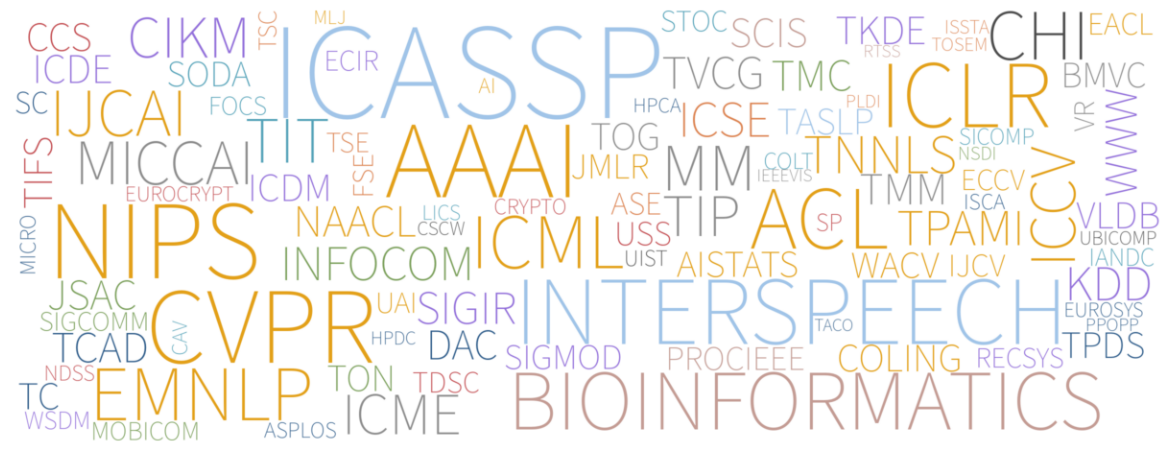
📦 数据集内容 · What's in this dataset
| 路径 Path | 子集 Subset | 格式 Format | 说明 Description |
|---|---|---|---|
cache/cache.jsonl.gz |
papers(默认 / default) |
gzip-compressed JSON Lines (UTF-8) | 每行一篇论文 · One paper per line; one JSON object per line |
cache/abstract_backfill_progress.jsonl.gz |
abstract_backfill_progress |
gzip-compressed JSON Lines (UTF-8) | 摘要回填流水线的进度/断点记录,不是论文元数据;仅供工作流恢复使用 · Append-only progress log of the abstract-backfill pipeline (not paper records); used by the workflow to resume between runs |
Hugging Face 会自动为 cache.jsonl.gz 生成 Parquet 视图,也可直接用 datasets.load_dataset(...) 读取,无需手动解压。Hugging Face also exposes an auto-generated Parquet view, so datasets.load_dataset(...) works out of the box.
💡 Dataset Viewer 与
datasets.load_dataset("youngfish42/PaperVault")默认展示/加载的都是papers子集(即cache/cache.jsonl.gz)。如需查看回填进度,请在 Viewer 顶部下拉框切换到abstract_backfill_progress,或调用load_dataset("youngfish42/PaperVault", name="abstract_backfill_progress")。The Dataset Viewer anddatasets.load_dataset("youngfish42/PaperVault")both default to thepaperssubset (cache/cache.jsonl.gz). To inspect backfill progress, switch the Viewer's subset dropdown toabstract_backfill_progressor callload_dataset("youngfish42/PaperVault", name="abstract_backfill_progress").
📐 字段 Schema
| Field 字段 | Type 类型 | Notes 说明 |
|---|---|---|
paper_name |
string | 论文标题(已归一化)· Normalised paper title |
paper_authors |
list[string] | 作者列表,按原始顺序 · Author names in order |
paper_url |
string | 论文在原始平台的链接(PDF 或落地页)· Canonical URL on the venue's site (PDF or landing page) |
paper_abstract |
string | 摘要;未回填时为空字符串 · Abstract; may be empty when not yet backfilled |
paper_code |
string | 从摘要中抽取出的 GitHub 仓库 URL;"#" 是「未发现代码链接」的占位符 · GitHub repository URL extracted from the abstract; "#" is the sentinel for "no code link discovered" |
conf |
string | 会议+年份标识,如 ACL2024、NIPS2023、CVPR2025;去掉末尾四位数字即可得到会议系列。注意 NeurIPS Proceedings 沿用历史命名 NIPS{year}。Venue + year identifier (e.g. ACL2024, NIPS2023, CVPR2025). Strip the trailing 4-digit year to recover the venue series. Note that NeurIPS Proceedings entries use the historical name NIPS{year}. |
缺失字段请按空字符串处理。Treat missing fields as empty strings.
⬇️ 获取方式 · How to download
下面三种方式任选其一即可,无需克隆 GitHub 仓库。Pick any one of the three options below — no GitHub clone is required.
方式 A · Option A — huggingface_hub(推荐 / recommended)
from huggingface_hub import hf_hub_download
import gzip, json

path = hf_hub_download(
    repo_id="youngfish42/PaperVault",
    filename="cache/cache.jsonl.gz",
    repo_type="dataset",
)

with gzip.open(path, "rt", encoding="utf-8") as f:
    for line in f:
        record = json.loads(line)
        # 在这里处理一条记录 · do something with the record
方式 B · Option B — datasets
from datasets import load_dataset

ds = load_dataset("youngfish42/PaperVault")
print(ds[next(iter(ds))][0])
数据集只有一个默认 split(非 ML 训练集),不要传
split="train"。Single default split — do not passsplit="train".
方式 C · Option C — huggingface-cli / 直接 HTTPS · Plain HTTPS
huggingface-cli download youngfish42/PaperVault \
    cache/cache.jsonl.gz --repo-type dataset --local-dir ./data
💡 文件压缩后约 120 MB(会随数据持续增长),解压后是 GB 级 JSONL 流,请按行流式读取,不要整体载入内存。The file is ~120 MB compressed (and growing) and decompresses to a multi-GB JSONL stream. Stream it line-by-line rather than loading the whole thing into memory.
🔁 更新节奏 · Update cadence
数据集由三个 GitHub Actions 工作流负责重建并推送到本 Hub 仓库 / The dataset is rebuilt and pushed to this Hub repo by three GitHub Actions workflows:
| 工作流 Workflow | 触发节奏 Schedule | 推送的内容 What it pushes |
|---|---|---|
collect_papers |
每月 15 号 16:00 UTC + 手动触发 · 15th of every month at 16:00 UTC + workflow_dispatch |
增量抓取新发现的会议/年份组合 · Incremental crawl of newly-discovered conference/year combinations |
backfill_abstracts |
每月 1 号 00:00 UTC + 手动触发 · 1st of every month at 00:00 UTC + workflow_dispatch |
为已有论文回填 paper_abstract · Adds paper_abstract for papers that were collected without one |
update_readme |
仅手动触发 (workflow_dispatch) · Manual only (workflow_dispatch) |
默认仅刷新 README 与统计;当输入参数 mode=force 时执行全量重建 · Refreshes the README and statistics by default; performs a full rebuild only when invoked with mode=force |
每次推送都使用 Hugging Face 的 parent_commit 乐观锁机制,避免并发覆盖。Each push uses Hugging Face's parent_commit optimistic-lock mechanism to avoid silently overwriting concurrent updates.
🌐 线上服务 · Live Service
无需下载数据集即可直接体验 Web 检索: No need to download the dataset — try the web search directly:
🔗 关联仓库 · Related repository
如果你需要完整的搜索 Web UI(智能搜索 + Web of Science 风格的高级查询 DSL)、REST API(/api/v1/*)、抓取 / 合并 / 摘要回填流水线源码、收录会议范围、统计仪表盘、项目截图或贡献指南,请前往 GitHub 项目仓库。If you are looking for the full search Web UI (smart search + Web-of-Science-style advanced query DSL), the REST API (/api/v1/*), the crawling / merging / abstract-backfill pipelines source code, conference coverage, statistics dashboards, screenshots or contribution guidelines, please visit the GitHub repository.
👉 github.com/youngfish42/PaperVault
📜 许可证 · License
代码以 GPL-3.0 发布;每条论文记录的著作权仍属于原作者 / 出版方,本数据集仅重新分发公开可获取的元数据与链接。Code is released under GPL-3.0; individual paper records remain the IP of their authors/publishers — this dataset only redistributes publicly available bibliographic metadata and links.
- Downloads last month
- 2,241